If you were a kid in the late 90s and early 2000s, the opening scene of 28 Years Later will spark some memories for you. I’m sure I’m not the only one who debated with their friends which Teletubby was the best one in the group (it was Tinky Winky). Danny Boyle and Alex Garland open their third installment in the 28 Days Later franchise with a group of young children gathered around a television to watch an episode of Teletubbies as their household is wrecked by the infected. Moments later, we see the Sun Baby do her infamous giggle before things turn bloody. We are then taken back to the gritty world we’ve come to know so well. However, this director-writer duo doesn’t retread old ground as you might expect. Instead, they give us a coming-of-age zombie film complete with deepened lore, gnarly kills, and dynamic performances.

This Is Not Your Mother’s Zombie Movie
Fans of the first two films will be surprised by how different this film is from the originals. Subverting expectations of yet another zombie-fueled survival film, 28 Years Later is about a young boy’s journey to save his mother. 28 years after the rage virus, the world has slowly found its way back to normal. Aside from a quarantined island known as Holy Isle, anyway. Much like M. Night Shyamalan’s The Village, this island has adopted an old way of living. The women are the ones who gather, cook, and care for children. The men hunt, provide, and protect.
12-year-old Spike (Alfie Williams) is preparing for his first hunt with his father, Jamie (Aaron Taylor-Johnson). Although, his ailing mother isn’t on board. Her illness causes migraines, memory lapses, and moments where she almost seems infected herself. She quickly forgets that Spike is about to risk his life on the mainland. The father and son set out in search of some infected. We quickly realize that Spike may think he’s ready to face the ugliness of the world outside the Holy Isle gates. However, when he and Jamie are caught in the web of an Alpha and his horde, his innocence and naivety are front and center. 28 Years Later gives us zombies, but we quickly learn that Garland’s script is deeper than that.

Follow the Yellow Brick Road
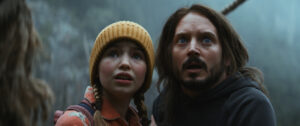
Serving as an interlude of sorts, Spike uncovers his father’s infidelity. He is also surprised to find out that there is a doctor on the mainland who could help his mother. Driven by his desire to save Isla (Jodie Comer), the two set off together unnoticed. Spike and Isla encounter the two different types of infected introduced. The obese, slow-moving zombies that crawl and squeal. And the standing, fast-moving naked zombies. Further expanding the lore, the Alpha infected seem to possess some level of intelligence, and they are hard to kill.
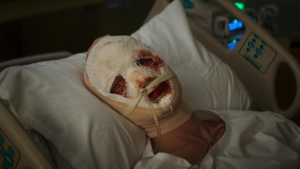
Teaming up with a Swedish soldier who saves them from a near-death experience, Spike and Isla make their way across the mainland. They are in search of Dr. Kelson (Ralph Fiennes). Kelson is a doctor who was known to do experiments and other odd things. Fiennes delivers one of the most impactful performances of the film. Kelson providing Spike and Isla with a different type of “cure”, the understanding of this new world and the inevitability of death. Boyle’s boneyard sequence is magnetic and full of unexpected emotion. Yet, it defines this new trilogy as something very different from the first two films.

The End is the Beginning
Spike returns to the isle to let Jamie know he isn’t returning and sets off on his own, only to encounter a man named Jimmy (Jack O’Connell). Jimmy survived the haunting opening scene of the film with his band of lookalikes. We can only anticipate how the story will continue in Nia DaCosta’s 28 Years Later: The Bone Temple. This film is the beginning of a journey for a boy whose eyes were opened to the brutal reality of the world after his home was ravaged by infection and fear. Reminiscent of Isaac Ezban’s PÁRVULOS, 28 Years Later is not just a zombie film but an introspective coming-of-age film serving as a rebirth of a genre favorite.