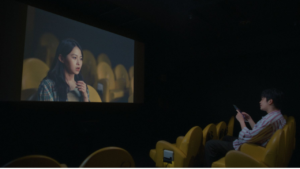
Kenichi Ugana has been carving out a name for himself in the horror landscape since his breakout with Visitors in 2023. However, his newest film, The Curse, cements him as one of the most inventive voices working today. Premiering at Fantastic Fest 2025, the film arrives as both a love letter to classic J-horror and a bold modernization of the genre. Drawing heavily from the traditions of Ringu and Ju-On but layering in anxieties about social media, algorithms, and internet obsession, Ugana crafts a story that feels both timeless and distinctly of this moment. The Curse is less about what lurks in shadows and more about the unseen horrors we carry in our feeds, our phones, and our curated online lives.
A Jolt of Adrenaline
Starting out with an intense prologue that ends in a grisly death, Ugana wastes no time signaling his intentions. The opening feels almost like a Truck-kun isekai (that infamous trope where a character’s sudden, violent death becomes the doorway into another world) except here the new realm is one of curses, dread, and inevitable doom. Instead of being whisked into a fantasy realm, the doomed character seems thrust into a nightmarish dimension of violence and inevitability. It’s a bravura sequence that jolts the viewer upright before the film downshifts into a quieter, more observational rhythm.
Skepticism Becomes Her
From here, we meet Riko (played with remarkable empathy by Yukino Kaizu), a hair salon receptionist whose life is a blend of mundane routines and endless scrolling. She runs errands, exchanges greetings with her neighbors, and fills the gaps with casual dips into Instagram. It’s in this in-between space that she notices something off: her old friend Shufen, whom she hasn’t spoken to in months, posts something disconcerting. When Riko tries to reach her, she’s met with silence. Only later, after contacting her ex-boyfriend Jiahao in Taiwan, does she learn the devastating truth that Shufen has been dead for six months, and her family believes she was the victim of a curse.
Riko doesn’t believe in curses, but her skepticism becomes harder to maintain as Shufen’s account continues posting, now targeting Riko and her roommate Airi (Reiko Ozeki) with increasingly menacing images and videos. What begins as a digital oddity spirals into a waking nightmare. Ugana sets up scenes that look like traditional horror setups (shadowy corridors, sudden silences, rising strings) only to pull the rug out from under the viewer. The expected jump scare never comes, but instead, dread builds through the glow of a phone screen, through faint distortions in a reflection, through the half-heard whisper of a notification.
Technically Speaking…
The cinematography heightens this effect, with the camera often circling or hovering just behind Riko, as though another presence is always there, just out of view. It mimics the aimless drifting of social media feeds (scrolling, swiping, never quite knowing what disturbing image will surface next). Combined with sound design that favors subtle auditory tricks over bombast, the film generates a lingering unease.
Kaizu anchors all of this with a performance that feels lived-in and raw. As Riko, she embodies the quiet determination of someone who refuses to accept the official narrative of her friend’s death, even as her own safety begins to unravel. Her fear is palpable, but so is her resolve, making her easy for audiences to root for. Ozeki brings levity and warmth as Airi, while supporting turns from Tammy Lin as Shufen, Yu as Jiahao, and Mimi Shao as Huijun enrich the film’s cross-cultural layers. And most importantly, the specter at the center of the story is presented with restraint. Ugana never lingers too long on the demonic figure, often showing her only in fragments (a flash of red fabric, a contortion of hair, a fleeting glimpse in the corner of a post). This makes every appearance deeply unsettling.
The Black Mirror Effect
Beneath the scares, The Curse is most compelling as a meditation on digital life. Social media becomes both the medium and the metaphor of the haunting: endless comparison, curated realities, and the pressure of online performance all mutate into something monstrous. The Curse spreads not through videotapes or voicemails, but through the infinite virality of posts and feeds. It’s an idea that feels inevitable, as if horror was always destined to follow us into the algorithm.
The Curse may not reinvent J-horror, but it revitalizes it with enough fresh ideas and sharp execution to feel vital. It’s unsettling, atmospheric, and at times outright disgusting, but never gratuitous. Above all, it’s a film that understands horror doesn’t just live in monsters or blood. It lives in the everyday technologies we trust without question. So, for fans of horror, Asian cinema, or anyone curious about how old ghosts haunt new platforms, The Curse is a must-see.