Fantasia Film Fest gave us a taste of the end of the world. Post-apocalyptic movies always catch my eye because horror has an extra layer of thrill when the dangers are tangible to the viewer. That’s why I made a beeline for The Well. I was filled with wonder at what horrors would have consumed the world as we know it in this universe. Additionally, post-apocalyptic/dystopian stories put us in the position to confront what one might do if (more likely, when) order falls.
The film follows a young woman’s journey after a wounded man arrives and discovers her family’s fresh water supply. The Well offers a personal glimpse into how survival and loss transform individuals. However, it lacks teeth. The movie was drowned in drama, though it left me thirsty for thrills, which made it hard for me to stay engaged.
Well, Well, Well…
The movie is heavily rooted in realism, which works to its advantage. The Well presents a world where the majority of the world’s drinking water has been contaminated. News reports, along with the visuals and sound of water, set the stage. With limited resources, survivors are left to fend for themselves or live in camps. While we do not see the camps firsthand, we can assume that the conditions are oppressive enough that people are willing to take risks to escape. It is highly likely that a contaminant, virus, or bacteria could enter our water supply and spread illness. We have already had a taste of how humans react in a pandemic. If environmental collapse to that degree occurred, people would use self-preservation and trust issues as a springboard to villainous behavior.
The Well exemplifies this complex balancing act through its character interactions. Sarah (Shailyn Pierre-Dixon) seems to represent a more innocent version of humanity. While she is trained for survival, she taps into her humanity when she makes decisions. Her parents, Paul (Arnold Pinnock) and Elisha (Joanne Boland), have been hardened by the times and are quick to shut others out to protect their resources. When Jamie (Idrissa Sanogo) arrives at their property, their first reaction is to pull a gun on him, even though he knows who they are. To be fair, Jamie is hard to read, and it’s clear that he’s hiding something when he arrives.

Show Us the Danger
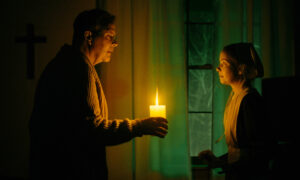
The main antagonist, Gabriel (Sheila McCarthy), is seemingly gentle but manipulative. Her dialogue feels sinister, but her words are indirect and coded. Her character would have landed for me if she were a bit more dangerous or cruel. We spend most of the movie with Gabriel and her flock. They don’t seem menacing, but they are a bit suspicious of Sarah. Ultimately, they are just people trying to survive. That detail nails the characters deeper into the realism of this universe, but at the cost of having high stakes.
The water and the illness feel like the most dangerous elements in the movie, yet we mostly hear talk of them. It creates dread because death is constantly looming, but the danger has to do more than loom to give audiences a thrill. We see an unnamed character consumed by the disease, but everyone else remained untouched by it until the end. We spend too much of the runtime watching Gabriel’s group suffer from a lack of resources. I found myself looking at my watch after the first 25 minutes. We also cut back and forth between Sarah’s parents when they look for her. We get quick flashbacks to the past, but outside of one parent getting hurt, nothing much happens.
The Well feels like a dystopian drama more than a thriller. However, it serves up post-apocalyptic dread swaddled tightly in reality.