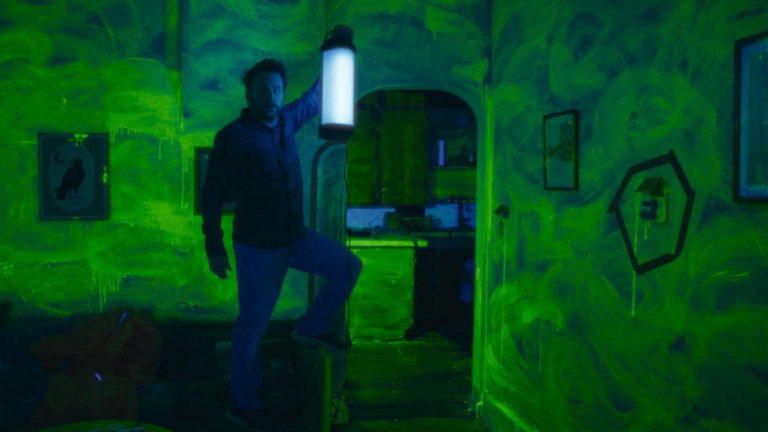
Premiering at South by Southwest, Kill Me is a movie about depression…but it refuses to behave like one. At a time when conversations about mental health are more public than ever, the film asks an unsettling question: what happens when someone with a history of depression insists they are telling the truth… and no one believes them? Instead of crafting a straightforward drama about mental illness (though the film certainly contains dramatic moments) or a horror film where depression becomes a literal monster (which it occasionally feels like), director Peter Warren does something far stranger. He turns it into a murder mystery… one where the central puzzle exists because the victim’s mental health history makes him impossible to believe.
The film stars Charlie Day (It’s Always Sunny in Philadelphia) as Jimmy, a man who does not want to die… yet something out there appears determined to kill him. Jimmy wakes up in his filthy bathtub, submerged in his own blood, with deep gashes across his arms. Panicking, he calls 911 and begs the dispatcher, Margot (Allison Williams), to understand something crucial: he did not do this to himself.
As he drifts in and out of consciousness, Jimmy insists that someone tried to murder him. Unfortunately, that claim becomes much harder to believe once he wakes up in the hospital surrounded by his parents (Jessica Harper and Michael Flynn) and his sister Alice (Aya Cash). Jimmy has a documented history of suicidal ideation, which means everyone around him assumes the obvious explanation. In almost any other film this setup would be grim and frustrating. Here, however, Day’s frantic stuttering, panicked shouting, and chaotic comedic timing create something unexpectedly funny.
The Problem With Being an “Unreliable” Victim
Watching Jimmy insist he has been the victim of attempted murder while everyone else calmly assumes he attempted suicide produces a strange kind of dark humor. That misunderstanding becomes the film’s central conflict. Jimmy may know what happened to him, but everyone else thinks they already know the answer. Once someone has been labeled unstable, proving otherwise becomes nearly impossible.
From there the film slips into full whodunit territory. Because Jimmy’s mental health history makes him unreliable in the eyes of everyone around him, he becomes the only person willing to investigate what actually happened. That means he is forced to become the detective in his own attempted murder. Margot, meanwhile, becomes far more involved in Jimmy’s life than she ever expected (or probably wanted).
What follows is a conspiracy spiral that feels suspiciously close to a Pepe Silvia–level meltdown. Jimmy refuses to accept that his past mental health struggles invalidate what he knows happened. He does not want sympathy… he just wants someone to listen. Jimmy’s desperation to be believed gives Day the perfect balance of comedy and tragedy to work with.
Comedy, Loneliness, and a Man Trying to Be Heard
This is where Day proves why comedians so often make excellent dramatic actors. His ability to play wild, chaotic characters also gives him access to something much deeper. Beneath the nervous energy is a palpable loneliness. The same comedic elasticity that allows actors like Bill Hader or Jim Carrey to pivot into devastating dramatic roles is at work here.
Supporting performances help ground the film as well. Giancarlo Esposito appears as Jimmy’s concerned psychiatrist, bringing a quiet steadiness to the chaos surrounding Jimmy’s unraveling narrative. Williams also gives Margot more emotional weight than the role initially suggests. Her performance gradually reveals moments of vulnerability and pain, especially when pieces of her own past surface.
Mental health diagnoses occupy an interesting space in the film. Receiving a diagnosis can bring relief because it offers language, explanation, and sometimes treatment after years of confusion. But diagnoses can also become labels that are impossible to escape, especially in a culture that often treats mental illness as explanation enough.
When a Diagnosis Becomes the Whole Story
The moment something goes wrong, everyone defaults to the same conclusion. Of course Jimmy hurt himself. Of course he is spiraling again. The possibility that something else happened never even enters the conversation.
The film explores that uncomfortable tension, and it becomes the mechanism that drives the entire mystery. Jimmy is not just trying to figure out who attacked him. He is trying to prove that his depression does not explain everything that happens to him.
Tonally, the movie takes a noticeable turn halfway through. The first half is frequently laugh-out-loud funny, while the second half leans much harder into trauma, suicide, and grief. The shift could easily have felt jarring, but it mostly works because humor is often how people survive the darkest moments. The film allows us to laugh with Jimmy first, which means that when the emotional weight hits later, it hits harder.
The biggest issue arrives in the third act. The journey Margot and Jimmy take while piecing together the mystery is genuinely entertaining. However, the actual solving of the crime drags on longer than it needs to. The reveal takes its time getting there, and the pacing slows noticeably as the film crawls toward its final answers.
Still, there is a lot to admire here. I laughed through much of the first half and found myself unexpectedly moved by the emotional honesty of the second. Kill Me ultimately becomes less about solving a mystery and more about the terrifying space between how people see us and how we see ourselves.
When mental illness becomes the only story people believe about you, proving otherwise can feel like trying to escape a ghost no one else can see. And sometimes the scariest part is that the ghost might not even be real… but the disbelief around you certainly is.