Impactful works of art can provide a portal between worlds – so, too, can how we process them. Who we are before and after these works are different people, pushed into a new reality by our experience and a willingness to dissect our reactions.
I was fortunate to attend the New York premiere of Bryn Chainey’s Rabbit Trap, featuring a Q&A with Chainey afterwards as part of Film at Lincoln Center’s Scary Movies XIII festival. What I encountered through the conversation echoed the experience of the film’s characters: an invitation for the audience to examine where we hide our shame.
Rabbit Trap gets its wide release starting September 12th, so if you came here solely for a review: yes, go see it. Yes, it will be covered on Bloody Broads. Yes, it is ambiguous in parts, and exactly what you would expect me to love. It’s a folk thriller, if not squarely folk horror. It’s set in 1976. You can now safely consume the rest of this piece sans spoilers.
Rabbit Trap and Beyond the Veil
The concept of “the veil” appears across spiritual practices. Hinduism, paganism, and some sects of Christianity use it as shorthand for the limitation of human perception and understanding, which prevents our full awareness of spiritual truths and connections. You may be familiar with hearing witches say there is a “thinning of the veil” or when paranormal investigators refer to certain times as when “the veil is thinnest”. I always find these phrases funny because… it’s a veil – isn’t it thin by definition? But for people who do not have a spiritual practice, the very idea of the veil is a semi-sheer blindfold to what lies behind it. Too woo woo, or esoteric, or just too weird. Whether from skepticism or lack of knowledge, confusion and avoidance keep us from concepts that can help us.
The veil in Rabbit Trap serves as a plot device and allegory in equal parts. If this concept being central to the film makes it feel too heady, consider the story a fairy tale in the traditional sense instead – entertaining to consume but possessing a lesson.
A Lovely Couple and an Unusual Situation
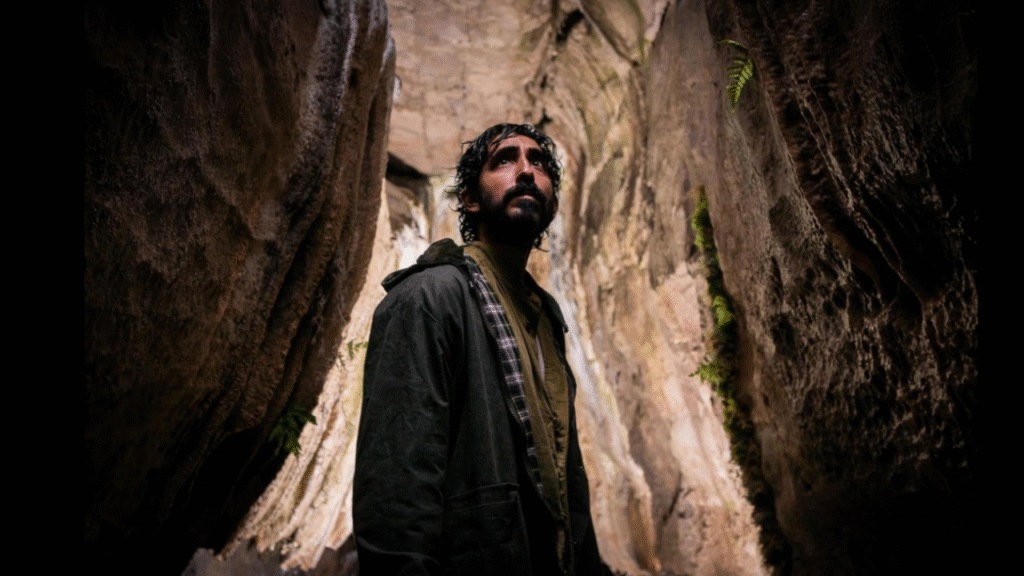
The couple at the heart of Rabbit Trap (performances by Dev Patel and Rosy McEwan as Darcy and Daphne Davenport that deserve their own essay) prove endearing protagonists for this fable of lifting the veils in our lives. They make experimental music together, so how can you not fall a little in love with them? Ushered into a spiritual initiation by encounters with nature and an intense kid neighbor, the Davenports’ shared unconscious leaks into their daily lives. What results is not self-discovery but a confrontation.
As more folklore merges with their concept of reality, so too does more of Darcy’s inner darkness, which he initially refuses to identify. “If you name something, it makes it real”, he laments, borrowing the melancholy phrasing of many who have done what spiritual folks will call “the inner work”. He has named his shame. He has begun to lift his veil.
Why Rabbit Trap is the Moment
What creeps from the Davenports’ journey beyond this moment is beautiful. It is also terrifying, as most truths are; a Willy Wonka’s Chocolate Factory of moss, mushrooms, and emotional mess. Daphne handles their discoveries better than most on-screen spouses, which helps assure the audience of this new reality. She becomes our guide.
When the Davenports decide to fully lift the veil and step into the realm past this world, they are rewarded with a new way to see what we deem shameful. It is no longer the monster in their bedroom corner but the compost from which their new life will grow. Romantic, yes, but practical too. My favorite kind of fairytale.
Whether you approach Rabbit Trap as a study in folklore crashing into the world as it was in 1976 or as an unnerving exercise in self-reflection, your journey is satisfying all the same. See it in theaters and come back to tell me what you think is beyond your veil.
Welcome to What Lies Beyond
Impactful works of art can provide a portal between worlds – so, too, can how we process them. Who we are before and after these works are different people, pushed into a new reality by our experience and a willingness to dissect our reactions.
I was fortunate to attend the New York premiere of Bryn Chainey’s Rabbit Trap, featuring a Q&A with Chainey afterwards as part of Film at Lincoln Center’s Scary Movies XIII festival. What I encountered through the conversation echoed the experience of the film’s characters: an invitation for the audience to examine where we hide our shame.
Rabbit Trap gets its wide release starting September 12th, so if you came here solely for a review: yes, go see it. Yes, it will be covered on Bloody Broads. Yes, it is ambiguous in parts, and exactly what you would expect me to love. It’s a folk thriller, if not squarely folk horror. It’s set in 1976. You can now safely consume the rest of this piece sans spoilers.
Rabbit Trap and Beyond the Veil
The concept of “the veil” appears across spiritual practices. Hinduism, paganism, and some sects of Christianity use it as shorthand for the limitation of human perception and understanding, which prevents our full awareness of spiritual truths and connections. You may be familiar with hearing witches say there is a “thinning of the veil” or when paranormal investigators refer to certain times as when “the veil is thinnest”. I always find these phrases funny because… it’s a veil – isn’t it thin by definition? But for people who do not have a spiritual practice, the very idea of the veil is a semi-sheer blindfold to what lies behind it. Too woo woo, or esoteric, or just too weird. Whether from skepticism or lack of knowledge, confusion and avoidance keep us from concepts that can help us.
The veil in Rabbit Trap serves as a plot device and allegory in equal parts. If this concept being central to the film makes it feel too heady, consider the story a fairy tale in the traditional sense instead – entertaining to consume but possessing a lesson.
A Lovely Couple and an Unusual Situation
The couple at the heart of Rabbit Trap (performances by Dev Patel and Rosy McEwan as Darcy and Daphne Davenport that deserve their own essay) prove endearing protagonists for this fable of lifting the veils in our lives. They make experimental music together, so how can you not fall a little in love with them? Ushered into a spiritual initiation by encounters with nature and an intense kid neighbor, the Davenports’ shared unconscious leaks into their daily lives. What results is not self-discovery but a confrontation.
As more folklore merges with their concept of reality, so too does more of Darcy’s inner darkness, which he initially refuses to identify. “If you name something, it makes it real”, he laments, borrowing the melancholy phrasing of many who have done what spiritual folks will call “the inner work”. He has named his shame. He has begun to lift his veil.
Why Rabbit Trap is the Moment
What creeps from the Davenports’ journey beyond this moment is beautiful. It is also terrifying, as most truths are; a Willy Wonka’s Chocolate Factory of moss, mushrooms, and emotional mess. Daphne handles their discoveries better than most on-screen spouses, which helps assure the audience of this new reality. She becomes our guide.
When the Davenports decide to fully lift the veil and step into the realm past this world, they are rewarded with a new way to see what we deem shameful. It is no longer the monster in their bedroom corner but the compost from which their new life will grow. Romantic, yes, but practical too. My favorite kind of fairytale.
Whether you approach Rabbit Trap as a study in folklore crashing into the world as it was in 1976 or as an unnerving exercise in self-reflection, your journey is satisfying all the same. See it in theaters and come back to tell me what you think is beyond your veil.
Jamie Kirsten Howard
more horror
The Retreat // A Queer allegory
WTF?! // 31 Days of Halloween — Day 18 (Re-Animator)
Arcadian// A SXSW 2024 Review: Yes, Another Nic Cage Movie
They Will Kill You Review // Slay The Rich White People
Shatter Belt // An anthology spun from DNA of greats but uniquely its own